
 Hong Kong SAR
 Macau SAR
 Singapore
 Mainland China

 Recruitment
 Staffing
 Executive
 Solutions


 Back

Companies Are Racing to Adopt AI. Who Should Be Their First AI Leader?
5 mins read
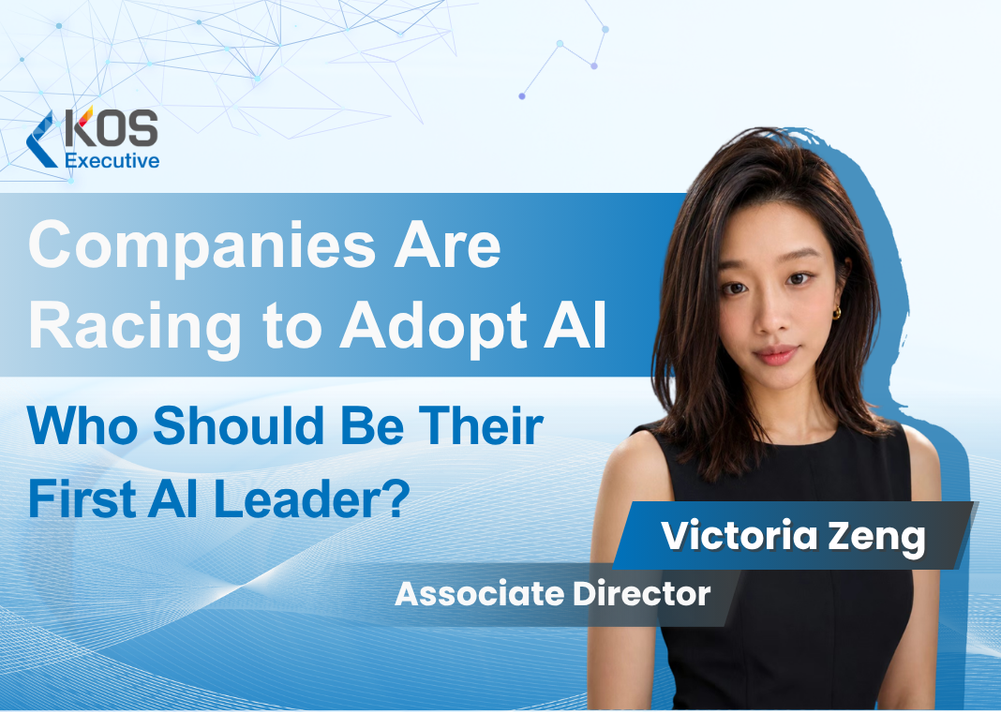
As competitors roll out new AI applications, companies want to move faster: make their products more competitive and improve internal efficiency. But when it comes to their own business, key questions remain unanswered.
• Where should they start?
• Who should lead the team?
• How will they measure success?
Hiring an AI leader to guide the effort seems like a reasonable first step.
Then the search begins, and a new set of questions emerges. Can someone with a research background turn ideas into practical applications? Can a candidate from a major tech company work within a smaller team and budget? Their projects look impressive, but which results did they personally deliver?
Management wants to see progress, and HR translates those expectations into specific job requirements. As the list grows, suitable candidates become harder to find. There is pressure to avoid passing over strong talent, but also concern about the time and cost of making the wrong hire. The role stays open, and business initiatives remain on hold.
Victoria, Associate Director at KOS International, specializes in executive search for AI and technology roles. Having experienced AI implementation firsthand at a globally recognized technology company, she looks beyond the résumé: How did a project become part of everyday work? Who brought people together when obstacles arose? What resources made it possible?
From Finding Someone Who Knows AI to Knowing Why They Are the Right Choice
Victoria starts her conversations with clients by returning to a specific question: Once this person joins, what part of the business do you most want them to improve, and how? Her approach to AI executive search begins with business objectives, uses those objectives to define the role, and then assesses candidates against their actual experience.
1.If the goal is to improve internal efficiency, the assessment should emphasize an understanding of workflows and experience putting AI into practice.
2.If the company wants to build advanced research capabilities, research judgment and the ability to build a team should carry appropriate weight.
3.If the biggest obstacle is getting initiatives moving across departments, the discussion should also address how responsibilities will be assigned and what organizational support will be available.
These goals may coexist, but the first AI leader needs clear priorities. Otherwise, research breakthroughs, product innovation, business growth, and productivity gains across the workforce all end up in the job description, leaving every candidate looking as though something is missing.
Victoria helps clients distinguish between experience the person must bring and capabilities that other team members can provide. Responsibilities such as coordinating across departments and allocating resources also need to be discussed upfront. With those questions resolved, HR has clearer screening criteria, and management can more readily agree on the right candidate.
They Delivered at a Major Tech Company. Can They Do It Here?
For Victoria, experience at a major tech company needs to be considered alongside what the candidate actually implemented. That background can be valuable, but employers need to be clear about what they value: technical expertise, experience moving initiatives through a complex organization, or a demonstrated ability to deliver.
The assessment should then follow the details of specific projects.
• How much of the team and technical foundation was already in place when the candidate took over?
• Which key decisions did they make?
• When problems arose with performance, cost, or reliability, what were they responsible for resolving?
Those answers provide the basis for a conversation about the new company’s circumstances. With a smaller team, a tighter budget, or business departments that are not yet able to participate, how would the candidate get started?
As recruitment consultants, we can help clients understand candidates’ actual contributions and experience. Technical assessments, however, require input from the client’s CTO or relevant technical leaders. Evaluating candidates together provides a clearer view of whether past success is relevant to the work ahead.
AI Adoption Across the Business Requires Clarity on Who Will Help
The responsibilities of a company’s first AI leader can quickly expand: choose the technology, build the team, develop products, and get every department to use them. Yet bringing AI into everyday work across an organization involves many specific tasks. Someone needs to understand departmental workflows, discuss with department heads which tasks are ready to change and which are not, and coordinate implementation across teams.
Boston Consulting Group’s 2026 survey of nearly 12,000 employees, managers, and leaders found that AI is changing jobs faster than companies are adapting how they work, underscoring the importance of a clear strategy.
The implication is that getting employees to use the tools is only a starting point. Management still needs to clarify how those changes should serve the business.
Alongside the technology, this requires substantial coordination. An AI leader can work with project managers, HR, or organizational development teams. If the company already has people coordinating work across departments, the search can place greater emphasis on technical expertise and implementation experience. If that support is missing, the company needs to decide who will provide it and how much experience the candidate needs in driving change across an organization.
Ultimately, the company should be able to explain why this person is the right choice. What similar responsibilities have they held? What experience will help them move the business forward with the resources and support currently available?
For companies considering an AI executive hire, the conversation can begin before the job requirements are fully defined. Start with the business priority you most want to move forward.
Connect with Victoria at victoria.zeng@kos-intl.com and explore what kind of AI leader your company needs today and how to identify the right candidate.
Latest News
View All
05.11.26
Insight, KOS Executive, Market Insights
Companies Are Racing to Adopt AI. Who Should Be Their First AI Leader?
As competitors roll out new AI applications, companies want to move faster: make their products more...
27.08.26
Case Study, KOS Solutions, Market Insights
KOS Solutions Customized Training Case Study | ACCA Professional Influence Advancement Course
At every stage of career development, professional expertise remains an essential foundation for car...
10.07.26
Insight, Market Insights
「一人公司」時代:企業的人才策略正在被重寫
OpenAI創辦人Sam Altman 曾預測,全球首間估值達10億美元的「一人公司」將很快...