
 Hong Kong SAR
  Macau SAR
  Singapore
  Mainland China
 Recruitment
  Staffing
  Executive
  Solutions

 Back
Back 
Hong Kong IT Market: Key Trends for Technology Leaders in 2026
6 mins read

What Hong Kong’s new cyber laws, AI+ strategy, and talent dynamics mean for CIOs and HR leaders.
This quarterly market update is prepared to help track how Hong Kong’s IT landscape is evolving over time. It is designed to share the developments shaping the market, the priorities currently facing CIOs in Hong Kong, and the technology topics attracting the most attention across organisations.
A new cybersecurity regime for Hong Kong
Hong Kong’s first dedicated cybersecurity law, the Protection of Critical Infrastructures (Computer Systems) Ordinance, came into force on 1 January 2026 and introduced a more structured approach to cyber risk for operators of critical infrastructure.
The Ordinance covers eight critical sectors, including energy, IT, transport, finance, healthcare, telecoms, major venues, and R&D parks. Designated operators must establish a Security Management Unit, conduct annual risk assessments, and arrange biennial security audits. Incident reporting timelines are now tighter: serious incidents must be reported within 12 hours, and other incidents within 48 hours. Penalties range from HK$300,000 to HK$5 million, with daily fines for ongoing non-compliance, and a Code of Practice issued on 1 January 2026 clarifies baseline requirements.
For technology and business leaders, this is not just a legal update. Any organisation that may be designated as a critical infrastructure operator now needs a clear view of its cyber posture, reporting processes, and governance model. This is already driving demand for cybersecurity, compliance, and risk professionals with both technical and regulatory experience.
AI+ moves from policy to execution
The 2026–27 Budget positions “AI+” and “Finance+” as the two central pillars of Hong Kong’s economic strategy. A new Committee on AI+ and Development Strategy, chaired by the Financial Secretary, signals that AI is now a board-level policy and business priority.
Government has earmarked HK$150 billion for the Northern Metropolis / San Tin Technopole as Hong Kong’s future innovation and technology hub. A new HK$10 billion Innovation and Technology Industry-Oriented Fund targets AI, robotics, life and health tech, and other future industries. Programmes such as the Digital Transformation Support Pilot are expanding to include AI and cybersecurity solutions for SMEs, while AI literacy initiatives aim to reach everyone from enterprise leaders to everyday citizens.
For employers, the signal is clear: AI adoption is no longer optional positioning. Organisations that align with the AI+ agenda may be able to tap funding and incentives, but they will also face rising expectations around AI use, governance, and skills development.
Agentic AI changes the conversation
Enterprise AI discussions have moved beyond chatbots and copilots to agentic AI — autonomous AI agents that can execute multi-step tasks with minimal human input. This marks a shift from experimentation to operational deployment.
42% of enterprises already have agentic AI in production, and 72% are either in production or running pilots. More than 75% of CIOs expect their organisations to have invested in agentic AI by the end of 2026. Line-of-business leaders now rival CIOs and CTOs in AI buying influence, which is reshaping enterprise decision-making. Data readiness remains the top bottleneck, while governance is lagging behind the speed of adoption. Gartner projects worldwide AI spending of US$2.52 trillion in 2026, up 44% year-on-year.
For CIOs, CDOs, and HR leaders, the challenge is balancing speed with control. Organisations are under pressure to move quickly, but those that scale AI without proper data foundations and governance may introduce new operational and regulatory risks.
What CIOs are prioritising in 2026
Info-Tech’s CIO Priorities 2026 report highlights five themes shaping technology leadership this year: maximising AI investments through measurable value, proactive risk management, federated data governance, stronger cybersecurity, and more disciplined IT financial management.
These themes reflect a broader reality: technology leaders are being asked to deliver innovation and resilience at the same time. For Hong Kong organisations, they provide a useful benchmark for strategy, capability building, and hiring priorities.
Cybersecurity threats keep intensifying
The threat environment in Hong Kong continues to intensify across multiple vectors. The script highlights ransomware incidents up 45% versus 2025, affecting more than 1,200 organisations and causing an estimated HK$250 million in damages. Phishing attacks rose 38%, with more than 3,500 incidents in the first half of 2026. Supply-chain breaches surged 60%, AI-powered cyberattacks increased 55%, and cloud security breaches rose 40% as organisations migrated data without adequate protections.
These figures reinforce the case for stronger security investment. Together with the new Ordinance, they make cybersecurity a board-level business issue rather than a purely technical concern.
Talent remains the real constraint
The Hong Kong IT talent market remains tight. The most in-demand roles continue to be in AI and data analytics, cybersecurity, cloud solutions, and compliance and risk. Around 25% of organisations report difficulty hiring junior and entry-level IT talent, the highest in Asia. At the same time, salary budgets are tighter even though average salaries are still rising, which means employers are being selective but remain competitive.
The same script notes that 87% of Hong Kong professionals now use conversational AI tools such as ChatGPT and Copilot in daily workflows. Contract hiring is growing, especially for change, risk, and operations roles, while talent retention remains the number one barrier to growth. Career development and flexibility are becoming key differentiators in the market.
For employers, the implication is practical: the limiting factor is often not only budget or technology, but the ability to attract and retain the right people. More organisations are responding with a mix of permanent hiring, contract talent, upskilling, and internal mobility.
Cloud spending keeps rising
Global public cloud spending is expected to surpass US$1 trillion in 2026, up 21% year-on-year, while Asia Pacific and China account for US$84 billion as the third-largest region. The main growth drivers are AI-enabled platforms, cloud-native development, and industry-specific cloud solutions.
Enterprise architectures are moving towards sovereign-by-design and multi-cloud models that distribute AI workloads across providers. As cloud budgets grow, Cloud FinOps is becoming a board-level priority, linking architecture decisions more closely to financial discipline.
This has direct hiring implications. Skills in cloud architecture, FinOps, governance, and multi-cloud operations remain in short supply, but they are increasingly essential to balancing cost, risk, and innovation.
Looking ahead
From a technology recruitment perspective, these trends are already shaping hiring conversations, role design, and leadership structures in Hong Kong. Cybersecurity and compliance roles are expanding, AI and data demand is broadening across sectors, and organisations are using a more flexible mix of permanent and contract hiring to deliver transformation.
For technology, HR, and business leaders, 2026 is shaping up to be a year in which regulation, AI adoption, cyber resilience, and talent strategy become even more tightly connected.
Closing thoughts
Hong Kong’s IT market continues to evolve quickly as regulation, AI adoption, cyber risk, cloud investment, and talent pressures increasingly intersect. By tracking these developments each quarter, it becomes easier to understand not only what is changing, but also where technology leaders are likely to focus next.
If you would like to discuss any of these trends in more detail — whether from a hiring, talent mapping, or broader market perspective — please feel free to contact Bonnie Chan at bonnie.chan@kos-intl.com for further discussion.
Latest News
View All
27.08.26
Case Study, KOS Solutions, Market Insights
KOS Solutions Customized Training Case Study | ACCA Professional Influence Advancement Course
At every stage of career development, professional expertise remains an essential foundation for car...
10.07.26
Insight, Market Insights
「一人公司」時代:企業的人才策略正在被重寫
OpenAI創辦人Sam Altman 曾預測,全球首間估值達10億美元的「一人公司」將很快...
04.06.26
Company News, Insight, Market Insights, News
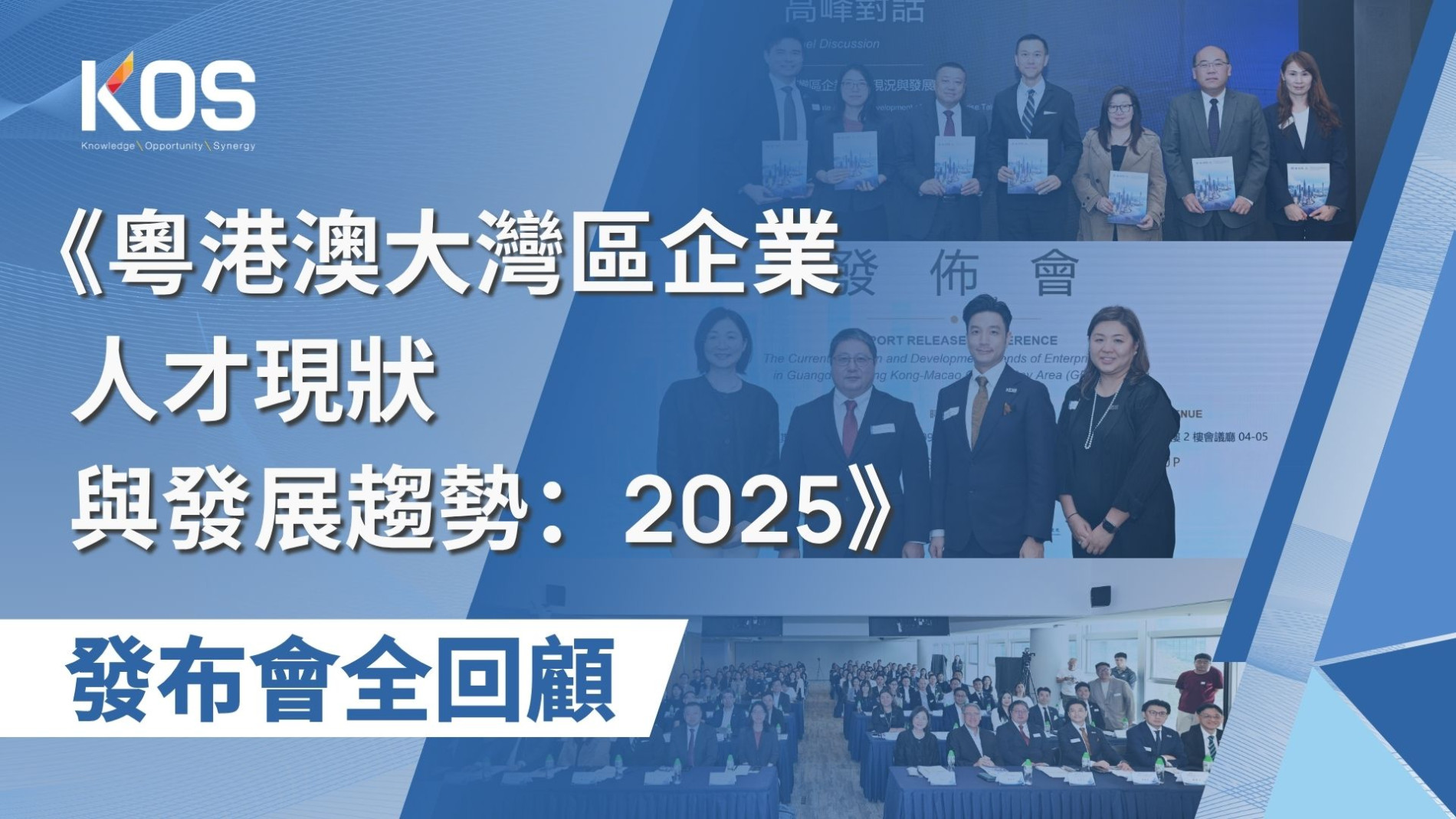
《粵港澳大灣區企業人才現狀與發展趨勢:2025》發布會全回顧
2026年5月28日,KOS高奧士國際人才集團聯同中山大學粵港澳發展研究院、中山...