
 Hong Kong SAR
  Macau SAR
  Singapore
  Mainland China
 Recruitment
  Staffing
  Executive
  Solutions

 Back
Back 
Five Career Capabilities Shaping Mainland China’s Talent Market in 2026
7 mins read
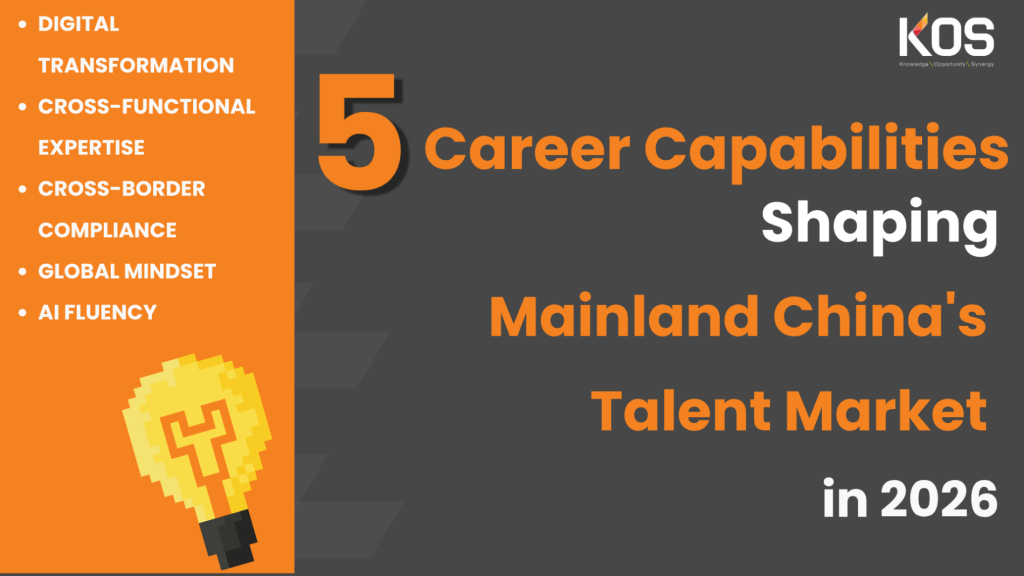
In 2026, Mainland China’s hiring market is becoming sharply more structured. Opportunities are are increasingly going to people who are upgrading their skills faster than everyone else, and the talent market as a whole is entering a new era defined by cross-functional capabilities, global perspective, and technology fluency.
With 17+ years in the recruiting industry, our KOS team interacts with tens of thousands of candidates and thousands of HR leaders and business heads every single year. We’ve distilled all of that frontline intelligence into 5 skill keywords that are actively reshaping the workplace in Mainland China.
Instead of stressing about whether you’ll get left behind, start here: how many of these 5 do you already have, and which one is worth making your top priority this year?
Skill #1: Digital Transformation
Digital transformation has moved well beyond “upgrading your tech stack.” It’s now about fundamentally rebuilding how business gets done.
Across HR, finance, marketing, and supply chain, job descriptions for key roles increasingly list “data analysis,” “hands-on AI tools experience,” and “business insight” as baseline requirements, not nice-to-haves. And when companies evaluate candidates today, they’re pushing on one core question:
Can you walk me through a specific example where your digital initiative actually moved the needle on cost, time, or conversion?
A quick self-audit:
Take a look at your current role. Is there a process you could redesign using data or technology to make it faster or more accurate?
This year, can you pick one digital or AI tool that’s directly relevant to your work, get genuinely good at it, and produce one or two measurable wins?
The moment you can clearly say “I used this tool and it saved the team X hours, cut costs by Y%, or improved conversion by Z%,” your practical digital fluency will already be more compelling than most people’s on the market.
Skill #2: Cross-Functional Expertise
Single-function, single-skill roles are being phased out fast. What’s replacing them is a new kind of talent profile built on business understanding, technology application, and strategic collaboration working together.
Companies are no longer just looking for “the best person in one department.” They want people who can read the big picture, get into the weeds when needed, and drive cross-functional execution, all at once. Hiring has shifted from “filling roles by function” to “finding problem-solvers by business challenge,” and companies are actively willing to pay a premium for candidates who can carry multiple responsibilities.
For individuals, depth in a single area still matters. But what determines your career ceiling is how many capabilities you can wire together into a combination that’s genuinely hard to replicate.
If you’re still in the earlier stages of your career, try this framing:
First, lock in your main arena, whether that’s HR, finance, tech, marketing, or something else that feels like your strongest foundation.
Then intentionally build toward an adjacent capability: if you’re in HR, learn the business and data side; if you’re in finance, develop operational and industry fluency; if you’re in tech, get closer to product thinking and the end user.
The progression from a T-shaped professional to a pi-shaped one is the path most high-performing composite talent has walked.
Skill #3: Cross-Border Compliance
As Chinese companies push deeper into international markets, compliance fluency has become a genuine baseline requirement for key roles, not just a legal department concern.
Over the past few years, going global has evolved from “dipping a toe in” to “going all in.” From cross-border e-commerce in South China to manufacturers expanding out of the Yangtze River Delta, compliance is no longer something you fix after the fact. It’s a critical variable in up-front business decisions. One compliance misstep can cost you several times over, or wipe out everything you’ve built. The people who are truly valued are those who can anticipate and address risk at the design stage, not clean up messes after they happen.
Whether you’re in HR, legal, finance, or a business unit, understanding the compliance logic of your industry and target market is becoming a key credential for anyone who wants to operate on the global stage.
Even if your company doesn’t have large-scale overseas expansion on the near-term roadmap, you can start building this edge now:
• Stay current on overseas regulatory trends relevant to your industry, whether that’s data privacy, content rules, environmental standards, or labor law.
• In your resume and interviews, don’t just say “I owned X process.” Add the layer: here’s how I balanced efficiency and compliance within that process.
• In day-to-day work, start weaving compliance thinking into how you design workflows and prevent risk, rather than treating it as a cleanup task after something goes wrong.
Skill #4: Global Mindset
As companies push further overseas, the race for talent has gone global right along with them.
What actually gives you an edge today isn’t just having international experience somewhere on your resume. It’s showing that you have genuine global perspective and can actually get things done across different cultures and markets. In our executive search work, we’re seeing the question shift away from “have you worked abroad?” and toward: When you were overseas, what specific problem did you solve? What did you actually build or fix?
Going global no longer just means getting your product into another country. It means building sustainable business systems and teams across fundamentally different markets. That takes real international business judgment, the ability to communicate and lead across cultures, and the skill to bring together resources from multiple geographies and make them work.
No international background? Here are three things you can start doing right now to build a genuine global perspective:
• Get involved in cross-regional projects, even cross-city ones, and push yourself to understand how customers and teammates in different markets actually think through problems.
• Follow the global leaders in your industry. Study their product logic, their brand narrative, and how they’ve tackled different markets.
• Make this a regular question in your own work: if I were doing this in a completely different country or market, what would need to change, and how would I adjust?
When you can consistently take what you’re observing across different markets and turn it into sharper business decisions, that perspective starts paying dividends in ways you might not even notice right away.
Skill #5: AI Fluency
AI has gone from a nice-to-have to a baseline expectation for any role that matters.
What companies actually care about isn’t how many AI tools you’ve experimented with. It’s whether you can connect your expertise, the right AI application, and a real business outcome within your specific role.
Different fields have different AI priorities. Here’s a quick breakdown to help you figure out where to focus:
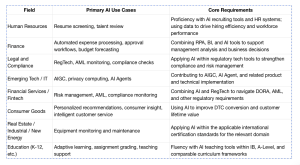
You don’t have to become an AI expert overnight. But you can start small and make it concrete:
• Pick one AI use case that maps directly to your current role.
• Run a small pilot. See whether it actually improves efficiency, quality, or the experience in a way you can point to.
• Write it down. Over time, that becomes a genuinely compelling story in interviews and performance reviews.
These 5 Skills Come from Real Hiring Practice in Mainland China
These five skills were pulled from the KOS 2026 Mainland China Talent Trends report, which is grounded in real hiring patterns, not theory.
The full report breaks down what’s actually being valued across 11 industry sectors: Human Resources, Finance, Legal and Compliance, Emerging Technology, Fintech, Financial Services, Consumer Goods, Retail, Real Estate, Industrial and New Energy, and Education. It covers different role levels and career stages, all specifically within Mainland China’s market context.
Here’s a practical way to get real value out of this report:
• Pull up the section for your industry and see what’s actually shifted in role requirements and capability expectations from 2025 to 2026.
• Pick one or two areas where you have genuine interest and real room to grow.
• Build a 2026 development plan around those areas, and use the trend data to make deliberate calls about where to put your energy.
Download the full report now
Latest News
View All
06.05.26
Career Advice, Insight, Market Insights
Five Career Capabilities Shaping Mainland China’s Talent Market in 2026
In 2026, Mainland China’s hiring market is becoming sharply more structured. Opportunities are...
15.04.26
Company News
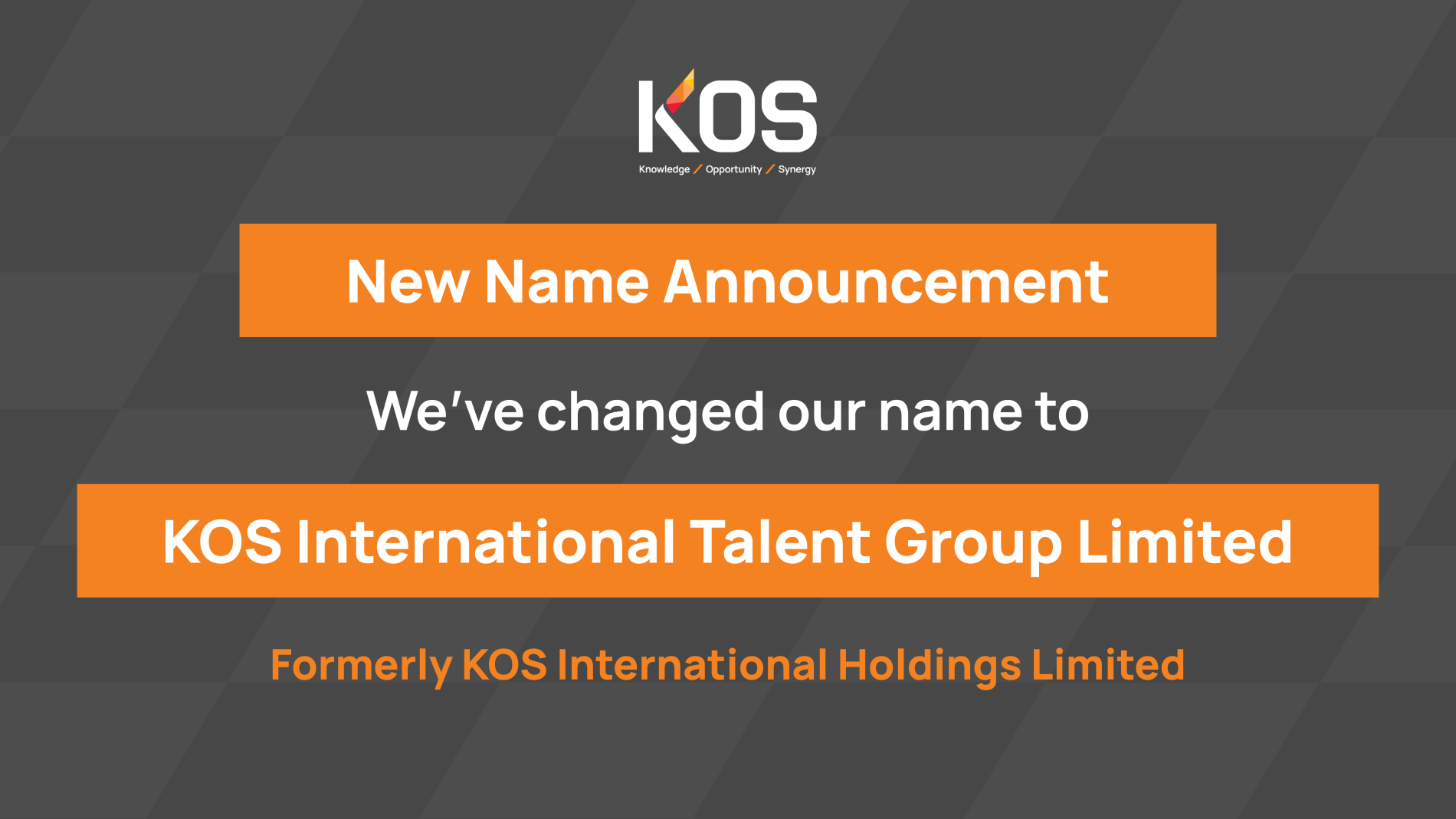
Corporate Name Change Announcement: KOS International Talent Group Limited
We are pleased to announce that our corporate name has officially changed from KOS International Hol...

09.04.26
Company News
Welcoming Daisy Qin to KOS International
We’re very pleased to welcome Daisy Qin to KOS International as Manager, focusing on financial...